Controlled Materials, Lighting, and Count Demo

CEF report · materials_and_light_v1

Experiment at a Glance

Question: How reliably do two SDXL checkpoints follow controlled changes to material, image-relative light direction, and object count?

Design: 2 checkpoints × 6 predeclared tests = 12 generated images; fixed-seed controlled counterfactuals.

Scope: portfolio demonstration.

Interpretation boundary: Scores and pass/fail labels below are machine observations, not ground truth. Human adjudication is a required publication gate.

Generated12
Analyzed12
Avg Score8.04
Wildcard0
Semantic1
Intent Fails3
Eval Conf0.98
Reference Assisted0
Reference DeltaNone

Controlled Manifold: 12 Generated Images

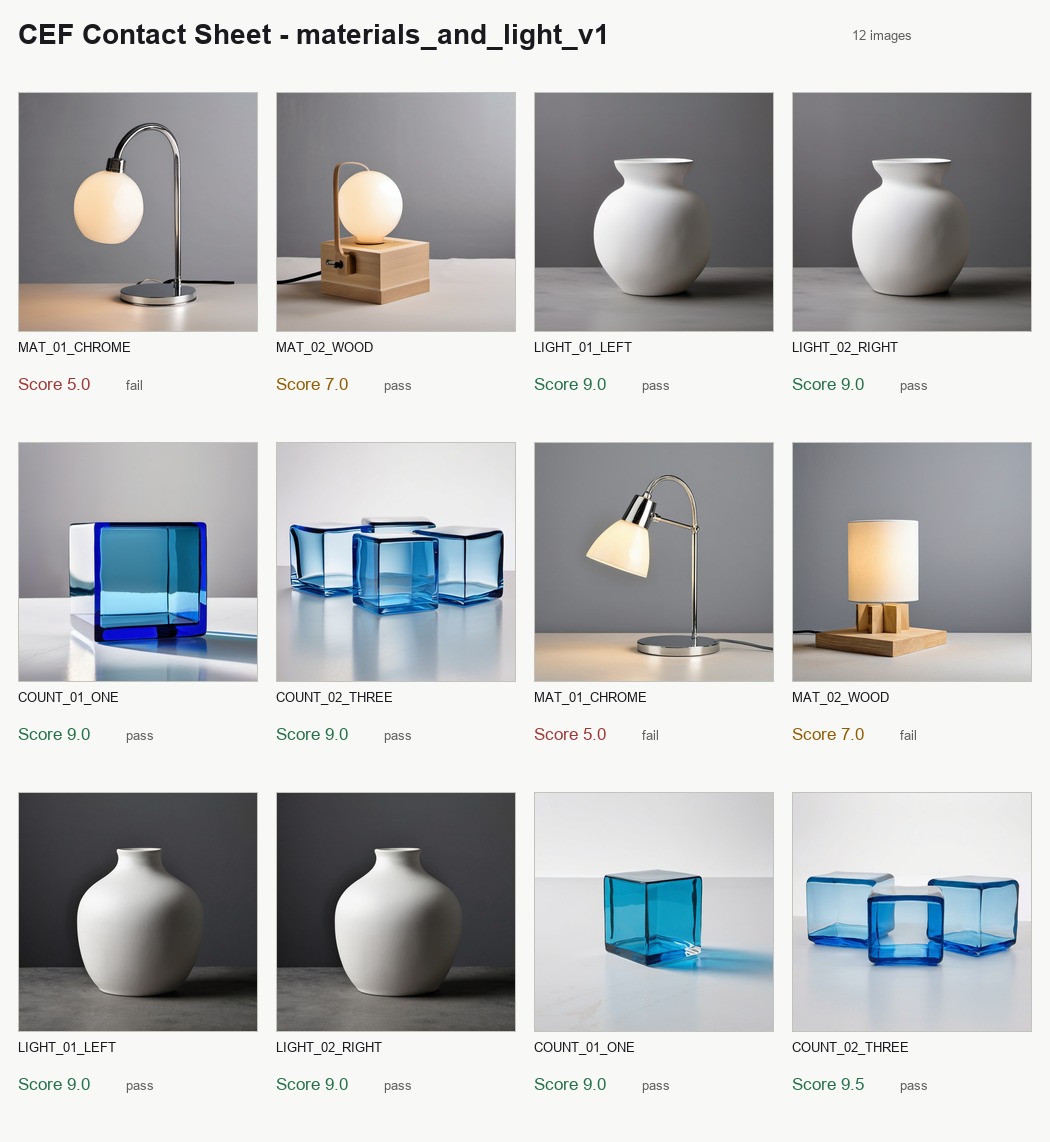
Open the contact sheet to inspect the paired checkpoint and counterfactual results at full size.
Contact sheet of all generated demo images and machine scores

Human Adjudication

5 pass / 7 fail. Machine agreement: 8 of 12 records.

Approved by Alex Led on 2026-08-14T16:35:36-04:00. Human findings supersede machine pass/fail labels where they disagree.
CheckpointTestMachineHumanAgreementHuman observation
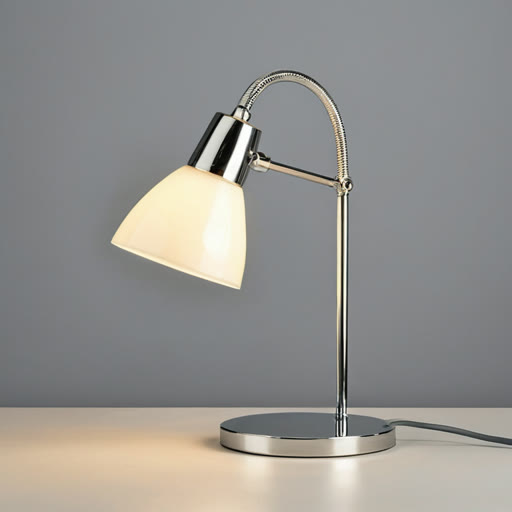
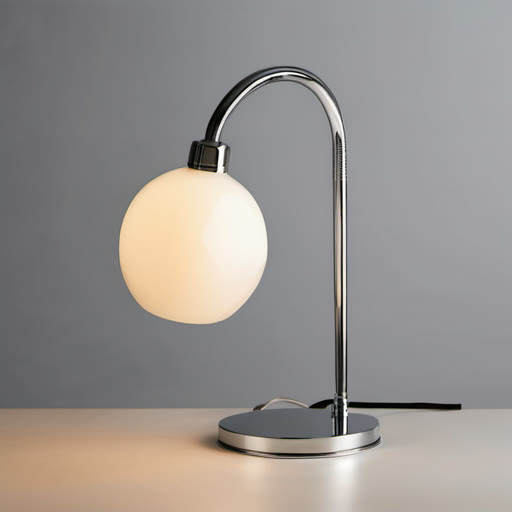
checkpoint_aMAT_01_CHROMEfailfailyesThe base and stem are reflective chrome, but the glowing cream globe is not chrome; the central material instruction is contradicted.
checkpoint_aMAT_02_WOODpassfailnoThe support and base read as pale wood, but the large glowing globe reads as glass or plastic rather than unfinished wood. Qwen overlooked this contradiction on retry.
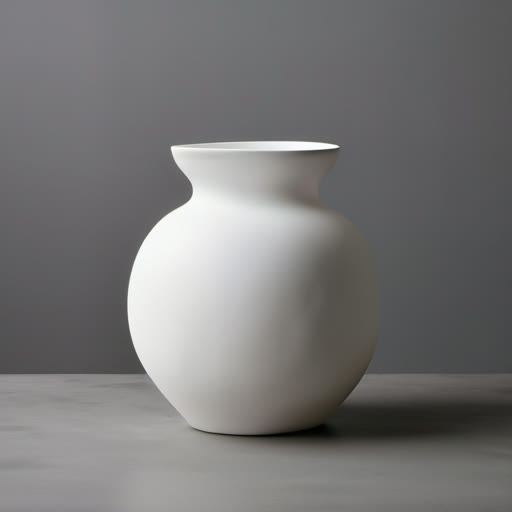
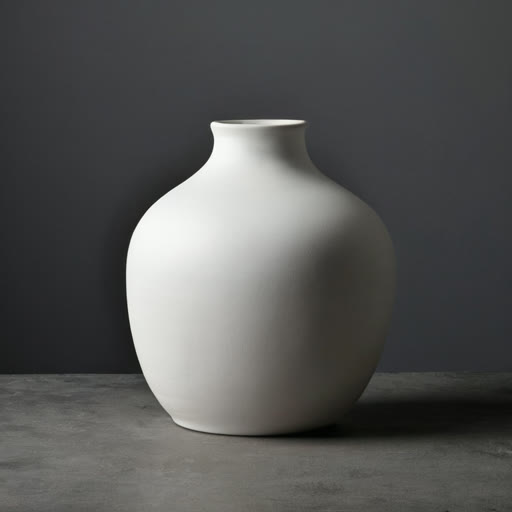
checkpoint_aLIGHT_01_LEFTpasspassyesThe vase is brighter on image-left and casts its dominant shadow toward image-right.
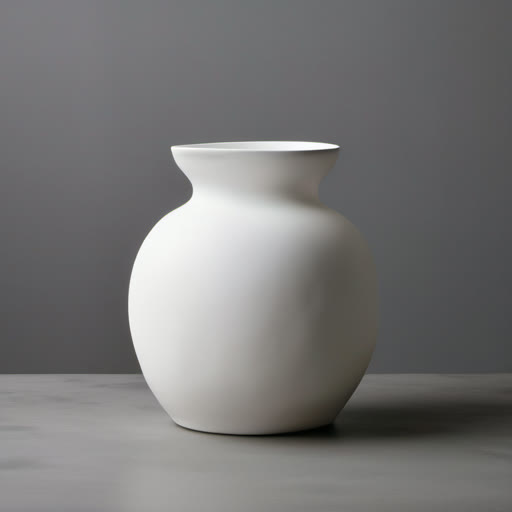
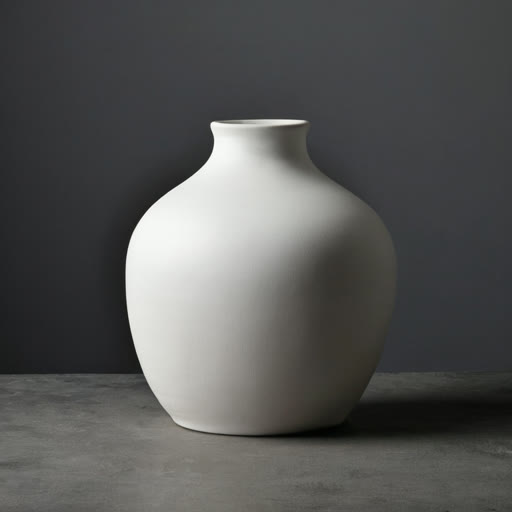
checkpoint_aLIGHT_02_RIGHTpassfailnoThe result remains brighter on image-left with a rightward shadow and is nearly identical to LIGHT_01_LEFT; the requested reversal is absent.
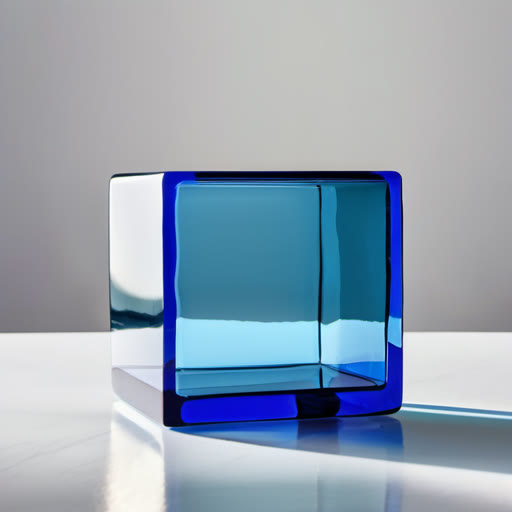
checkpoint_aCOUNT_01_ONEpasspassyesExactly one distinct translucent blue cube is visible. Minor edge and internal-refraction artifacts do not create a second object.
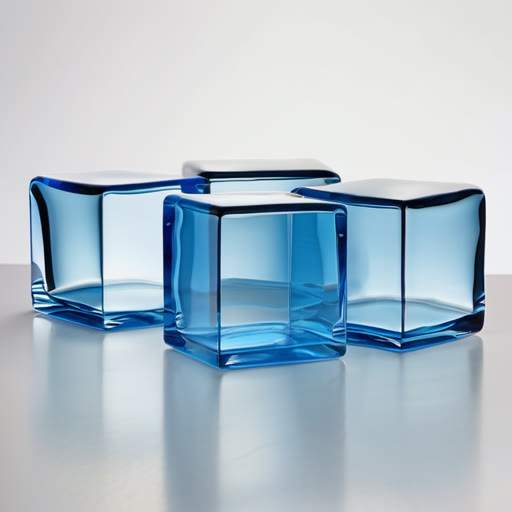
checkpoint_aCOUNT_02_THREEpassfailnoFour distinct translucent blue cube bodies are visible: left, rear-center, front-center, and right. This contradicts the request for exactly three cubes; Qwen also miscounted the image as three.
checkpoint_bMAT_01_CHROMEfailfailyesThe frame and base are reflective chrome, but the cream shade is not chrome; the central material instruction is contradicted.
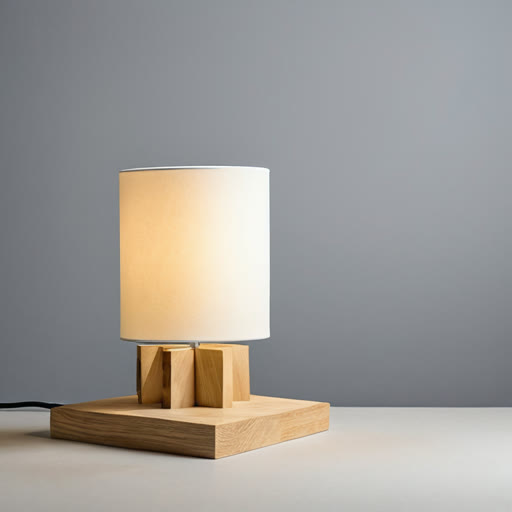
checkpoint_bMAT_02_WOODfailfailyesThe base and supports read as pale wood, but the cylindrical fabric shade is not wood; the central material instruction is contradicted.
checkpoint_bLIGHT_01_LEFTpasspassyesThe vase is brighter on image-left and casts its dominant shadow toward image-right.
checkpoint_bLIGHT_02_RIGHTpassfailnoThe result remains brighter on image-left with a rightward shadow and is nearly identical to LIGHT_01_LEFT; the requested reversal is absent.
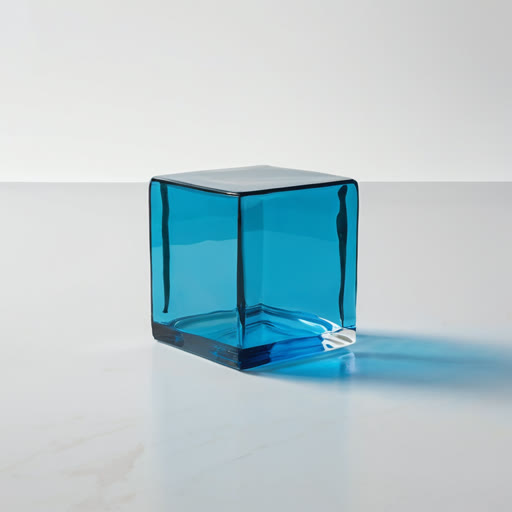
checkpoint_bCOUNT_01_ONEpasspassyesExactly one distinct translucent blue cube is visible. The faint tabletop veining and dark vertical glass streaks are minor artifacts.
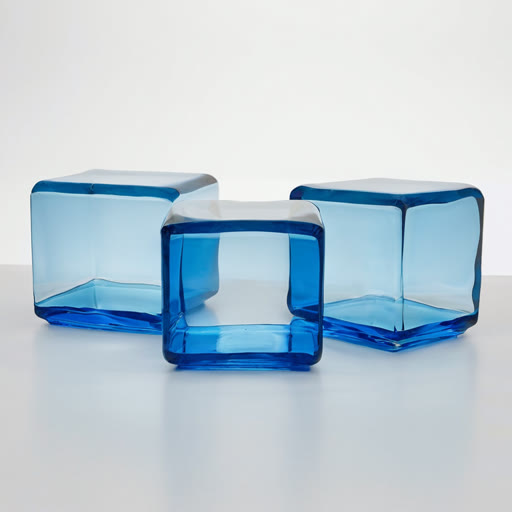
checkpoint_bCOUNT_02_THREEpasspassyesExactly three distinct translucent blue cubes are visible on a clean neutral surface.

Executive Summary

CheckpointStable Diffusion XL Base 1.0 vs RealVisXL V5.0 FP16 (baked VAE)
Overall8.04 / 10
ReliabilityMixed
PhotorealismNot targeted
AnatomyNot targeted
Animal PriorsNot targeted
Environmental RealismNot targeted
CreativityNot targeted
Dominant Latent Attractorsobject or artifact, portrait, documentary, ominous, photography
Failure PersonalityLowest-scoring behavior centers on mat 01 chrome.
Recommended UseReview detailed results before relying on this checkpoint.
CautionImage-left/image-right judgments require human review because vision-language models may use directional terminology or spatial evidence inconsistently.

Checkpoint Provenance

CheckpointCreatorDeclared licenseSHA-256Source
Stable Diffusion XL Base 1.0Stability AICreativeML Open RAIL++-M31e35c80fc4829d14f90153f4c74cd59c90b779f6afe05a74cd6120b893f7e5bmodel documentation
RealVisXL V5.0 FP16 (baked VAE)SG161222OpenRAIL++ (as declared by the creator model card)6a35a7855770ae9820a3c931d4964c3817b6d9e3c6f9c4dabb5b3a94e5643b80model documentation

Evaluator Provenance

FieldRecorded value
Modelcef-qwen3-vl-8b
ClientQwenEvaluationClient
Temperature0.1
Max tokens3000
Response modejson
Structured responseTrue
Directivesafe_demo_evaluator.txt
Directive SHA-2561a62099c51af5c69bd786aa0390e26693a018392917a84037c3c310935c5c2df

Credentials are never written to evaluator provenance.

Checkpoint Personality

Derived from 12 analyzed images; conceptual/hallucination records: 0.

Default Subject

  • object or artifact10
  • portrait8

Default Mood

  • documentary11
  • ominous3

Default Visual Language

  • photography12
  • text/poster7

By Checkpoint

CheckpointAverage ScoreImages
checkpoint_a8.06
checkpoint_b8.086

By Test

TestAverage ScoreImages
COUNT_01_ONE9.02
COUNT_02_THREE9.252
LIGHT_01_LEFT9.02
LIGHT_02_RIGHT9.02
MAT_01_CHROME5.02
MAT_02_WOOD7.02

Rubric Averages

Rubric FieldAverage ScoreImages
anatomy10.010
artifact_severity0.5612
composition9.4212
environment_quality9.3812
identity_retention10.04
lora_integration10.04
object_interaction9.619
prompt_adherence8.6712
style_adherence9.1212

Wildcard Observations

CategoryCount
No wildcard category counts yet.
SeverityCount
No wildcard severity counts yet.

Suggested Criteria

TestCategorySuggested Criterion
No suggested criteria yet.

Semantic Observations

CategoryCount
intent_conflict1
SeverityCount
minor1

Major Semantic Issues

TestCategorySeverityObservationEvidence
No major issues yet.

Semantic Suggested Criteria

TestCategorySuggested Criterion
COUNT_01_ONEintent_conflictThe top surface should exhibit natural light diffusion and refraction consistent with translucent glass material.

Intent Failure Check

Failure ModeCount
intent_conflict5
prompt_literalism3

Intent Failures

TestConfidenceFailure ModesExplanation
MAT_01_CHROME0.95prompt_literalism, intent_conflictThe prompt explicitly requires the lamp to be 'made entirely of polished chrome'. The presence of a non-chrome, translucent lampshade constitutes a direct contradiction. While the metal components are convincing, this single failure prevents full compliance with the test's core requirement.
MAT_01_CHROME0.98prompt_literalism, intent_conflictThe prompt requires 'entirely of polished chrome,' which is impossible for a lampshade that emits light and diffuses it — unless the shade is transparent or translucent. The image renders an opaque white shade, which cannot be chrome. This is not an aesthetic failure but a logical contradiction in material specification.
MAT_02_WOOD0.98prompt_literalism, intent_conflictThe prompt explicitly requires the lamp to be 'made entirely of unfinished pale wood'. The presence of a fabric shade constitutes a material contradiction, even if the wooden base is accurate. This violates the literal intent of the prompt.

Images

MAT_01_CHROME

Polished Chrome Material

checkpoint_a / none / MAT_01_CHROME · Score 5 · confidence 0.97
the lamp reads as polished reflective chrome rather than wood, ceramic, or matte plastic: 6
The metal base, stem, and arm exhibit strong specular highlights and clear reflections consistent with polished chrome. However, the lampshade is a translucent, diffused white material (likely frosted glass or plastic), which contradicts 'entirely of polished chrome'. The chrome components are visually convincing.
exactly one primary lamp is present: 10
Only a single desk lamp is visible in the frame, with no duplicates or extraneous objects.
the lamp is centered against a plain studio background: 8
The lamp is positioned near the center of the frame, with a uniform gray studio background and a light-colored surface beneath it. The composition is balanced.
reflections remain coherent and do not fragment the object: 7
Reflections on the chrome surfaces are generally coherent, showing smooth transitions and clear highlights. However, some areas of the curved arm show slight distortion or softening in reflection continuity, suggesting minor rendering artifacts.
pass_fail: failanatomy: Noneartifact_severity: 0.2composition: 8environment_quality: 8face_quality: Nonefoot_quality: Nonehand_quality: Noneidentity_retention: Nonelora_integration: Noneobject_interaction: Noneprompt_adherence: 6style_adherence: 7
fails human intent / confidence 0.95
The prompt explicitly requires the lamp to be 'made entirely of polished chrome'. The presence of a non-chrome, translucent lampshade constitutes a direct contradiction. While the metal components are convincing, this single failure prevents full compliance with the test's core requirement.
prompt_literalism, intent_conflict
Lampshade material contradicts prompt (not chrome)
The lampshade is a non-chrome material, which may be an artifact of the model's interpretation or a failure to fully respect the prompt.
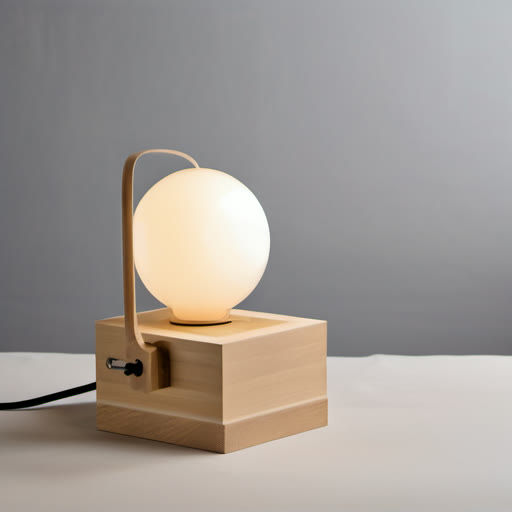
MAT_02_WOOD

Unfinished Wood Material

checkpoint_a / none / MAT_02_WOOD · Score 7 · confidence 0.98
the lamp reads as unfinished pale wood with visible grain rather than metal or ceramic: 8
The base and arm are clearly rendered in light-colored, unfinished wood with discernible vertical grain patterns consistent with pale wood. The material does not appear metallic or ceramic.
exactly one primary lamp is present: 10
There is only a single, complete desk lamp visible in the frame with no duplicates or partial objects.
the lamp is centered against a plain studio background: 8
The lamp is positioned near the center of the frame, with a uniform gray gradient background and a neutral white surface beneath it.
wood grain follows the object surfaces coherently: 6
Wood grain is visible on the base and arm, but appears somewhat inconsistent or artificially mapped in areas where curvature should break it (e.g., along the curved arm). The grain does not flow naturally around the spherical lampshade.
pass_fail: passanatomy: 10artifact_severity: 3composition: 8environment_quality: 9face_quality: Nonefoot_quality: Nonehand_quality: Noneidentity_retention: Nonelora_integration: Noneobject_interaction: 8prompt_adherence: 9style_adherence: 7
passes human intent / confidence 0.98
The prompt asks for an unfinished pale wood lamp, which is visually satisfied except for the grain’s incoherence on curved surfaces. This does not contradict the core intent but represents a minor generative artifact.
intent_conflict
Wood grain does not follow curved surfaces coherently, suggesting an artifact in texture mapping.
The wood grain on the curved arm appears artificially applied rather than naturally flowing with the object’s geometry. This may be a generative artifact, not an intentional design choice.
LIGHT_01_LEFT

Directional Light from Left

checkpoint_a / none / LIGHT_01_LEFT · Score 9 · confidence 1.0
the dominant illumination originates from image-left: 10
The vase exhibits a clear, soft gradient of light on its left side and a corresponding shadowed right side. The highlight is brightest on the upper-left curve, consistent with a single hard light source from the left.
the main cast shadow extends toward image-right: 10
A distinct, soft-edged shadow is visible on the tabletop directly beneath and to the right of the vase’s base, extending horizontally toward the image-right edge.
exactly one primary vase is present: 10
Only a single, centrally located vase is visible in the frame. No duplicates, partial objects, or background elements are present that could be mistaken for additional vases.
the vase reads as matte white ceramic: 9
The vase is uniformly white with a non-reflective, diffuse surface that lacks specular highlights or glossiness consistent with matte ceramic. However, the texture appears slightly too smooth and uniform for real ceramic; there are no visible pores, glaze variations, or subtle imperfections typical of handmade ceramic.
pass_fail: passanatomy: 10artifact_severity: 0composition: 10environment_quality: 10face_quality: Nonefoot_quality: Nonehand_quality: Noneidentity_retention: Nonelora_integration: Noneobject_interaction: 10prompt_adherence: 9style_adherence: 9.5
passes human intent / confidence 0.95
The image satisfies the prompt’s core requirements: directional lighting, shadow direction, single object, and matte white appearance. The material realism is slightly stylized but does not contradict the prompt's intent to depict a clean product photograph.
LIGHT_02_RIGHT

Directional Light from Right

checkpoint_a / none / LIGHT_02_RIGHT · Score 9 · confidence 0.98
the dominant illumination originates from image-right: 10
The vase exhibits a clear, soft gradient of light across its surface: the right side is brightest and most evenly lit, while the left side transitions into shadow. The highlight on the upper rim and the gradual falloff toward the base indicate a single directional source from the right.
the main cast shadow extends toward image-left: 10
A distinct, soft-edged shadow is visible on the tabletop directly beneath and to the left of the vase’s base. The shadow's direction aligns with a light source positioned to the right.
exactly one primary vase is present: 10
Only one vase is visible in the frame, centered on the tabletop with no duplicates or other objects.
the vase reads as matte white ceramic: 9
The vase is uniformly white with a non-reflective, diffuse surface that lacks specular highlights, consistent with matte finish. The texture appears smooth and slightly grainy under close inspection, which may suggest ceramic or a similar material. However, the absence of visible glaze lines or typical ceramic microstructure makes absolute identification ambiguous.
pass_fail: passanatomy: 10artifact_severity: 0composition: 10environment_quality: 10face_quality: Nonefoot_quality: Nonehand_quality: Noneidentity_retention: Nonelora_integration: Noneobject_interaction: 10prompt_adherence: 10style_adherence: 10
passes human intent / confidence 1.0
The prompt requested a matte white ceramic vase under right-side lighting with leftward shadow — all are visually present and consistent. The only ambiguity is material texture, which does not contradict the intent.
Material identification is ambiguous; the surface texture lacks definitive ceramic characteristics (e.g., glaze or pore structure).
COUNT_01_ONE

One Object

checkpoint_a / none / COUNT_01_ONE · Score 9 · confidence 0.98
exactly one cube is visible: 10
A single, clearly defined cube occupies the center of the frame with no other objects or fragments visible in any part of the image.
the cube reads as translucent blue glass: 9
The cube exhibits strong translucency with visible internal color gradients from deep blue to lighter cyan, and its surface reflects light in a way consistent with polished glass. However, the top edge appears slightly unnaturally sharp and uniformly colored, suggesting minor rendering artifact.
no fragments or secondary objects resemble additional cubes: 10
No fragments, shadows, reflections, or partial shapes suggest the presence of any other cube. The background and tabletop are uniformly clean with no hidden elements.
the tabletop and background remain clean and neutral: 10
The tabletop is a uniform white surface with clear reflections from the cube. The background is a smooth, gradient gray that transitions to white at the horizon line, free of any text, logos, or distracting elements.
pass_fail: passanatomy: 10artifact_severity: 0.2composition: 10environment_quality: 10face_quality: Nonefoot_quality: Nonehand_quality: Noneidentity_retention: 10lora_integration: 10object_interaction: 9.5prompt_adherence: 10style_adherence: 10
passes human intent / confidence 0.98
The image fulfills the prompt’s intent to show a single, clean product shot of a translucent blue glass cube on a white surface with no distractions.
semantic:intent_conflict / minor
The cube’s top edge is unnaturally sharp and uniformly colored, which may indicate a rendering artifact rather than true glass behavior.
Top edge of the cube shows no visible refraction or light diffusion typical of real glass; it appears as a flat, solid blue line against the background.
Minor top-edge artifact on the cube (possibly a rendering limit) slightly reduces material realism score to 9/10.
COUNT_02_THREE

Three Objects

checkpoint_a / none / COUNT_02_THREE · Score 9 · confidence 0.98
exactly three cubes are visible: 10
Three distinct cube-shaped objects are clearly visible, arranged in a row with no additional or missing cubes.
all three cubes read as translucent blue glass: 9
All three objects are blue and exhibit translucency with visible internal reflections and refractions consistent with glass. However, the top surfaces of all three cubes show a distinct white or light-gray sheen that does not match typical glass material behavior under this lighting.
the cubes are distinct and are not fused together: 10
The three cubes are clearly separated by visible gaps between them, with no shared edges or merged surfaces.
the tabletop and background remain clean and neutral: 10
The surface is a uniform, reflective white material with no visible texture or debris. The background is a plain, gradient white wall with no objects, logos, text, or distracting elements.
pass_fail: passanatomy: 10artifact_severity: 2composition: 10environment_quality: 10face_quality: Nonefoot_quality: Nonehand_quality: Noneidentity_retention: Nonelora_integration: Noneobject_interaction: 10prompt_adherence: 9style_adherence: 10
passes human intent / confidence 0.95
The image successfully fulfills the prompt's core requirements: three distinct cubes, clean background, and arrangement on a white surface. The only deviation is the material appearance of the top surfaces, which may be an artifact or misinterpretation rather than a failure to meet intent.
intent_conflict
Top surfaces of cubes exhibit unnatural white sheen inconsistent with typical glass material under this lighting, suggesting a rendering artifact or misinterpretation.
The top surfaces of the cubes have an unnatural white sheen that may be an artifact. This does not contradict the prompt but could indicate a material rendering error.
MAT_01_CHROME

Polished Chrome Material

checkpoint_b / none / MAT_01_CHROME · Score 5 · confidence 0.98
the lamp reads as polished reflective chrome rather than wood, ceramic, or matte plastic: 3
The base, stem, and joint are clearly rendered with a high-gloss, mirror-like chrome finish that reflects the environment. However, the lampshade is opaque, diffused white (or off-white), which appears to be ceramic or frosted glass — not chrome. The prompt requires 'entirely of polished chrome,' so this material mismatch constitutes a failure.
exactly one primary lamp is present: 10
There is precisely one desk lamp visible in the image, with no duplicates or extraneous objects.
the lamp is centered against a plain studio background: 8
The lamp is positioned near the center of the frame, with a uniform gray studio background and a neutral surface beneath it. The composition is balanced but slightly off-center due to the lamp’s angled orientation.
reflections remain coherent and do not fragment the object: 9
Reflections on the chrome surfaces are smooth, continuous, and coherent — no visible fragmentation or distortion. The only minor artifact is a slight softness in the reflection of the lampshade’s edge due to its diffuse material.
pass_fail: failanatomy: 10artifact_severity: 1composition: 8environment_quality: 8face_quality: Nonefoot_quality: Nonehand_quality: Noneidentity_retention: Nonelora_integration: Noneobject_interaction: 9prompt_adherence: 5style_adherence: 9
fails human intent / confidence 0.98
The prompt requires 'entirely of polished chrome,' which is impossible for a lampshade that emits light and diffuses it — unless the shade is transparent or translucent. The image renders an opaque white shade, which cannot be chrome. This is not an aesthetic failure but a logical contradiction in material specification.
prompt_literalism, intent_conflict
Lampshade is opaque white (ceramic/glass), not polished chrome — violates 'entirely of polished chrome' requirement.
The lampshade’s material contradicts the prompt. This is a structural failure, as it renders an object that cannot be made entirely of chrome while functioning as described.
MAT_02_WOOD

Unfinished Wood Material

checkpoint_b / none / MAT_02_WOOD · Score 7 · confidence 0.98
the lamp reads as unfinished pale wood with visible grain rather than metal or ceramic: 8
The base and support structure are clearly rendered as light-colored, unfinished wood with visible grain patterns. The cylindrical shade is fabric-like (off-white, matte), not wood. This contradicts the prompt's requirement that 'the lamp' be made entirely of wood.
exactly one primary lamp is present: 10
There is exactly one lamp assembly visible in the image, including its base and shade.
the lamp is centered against a plain studio background: 9
The lamp is positioned near the center of the frame, with a uniform gray studio background and a light-colored surface beneath it.
wood grain follows the object surfaces coherently: 7
Wood grain is visible on the base and support blocks, following their planar surfaces. However, the grain pattern appears somewhat artificial or stylized in places (especially on the vertical supports), lacking natural continuity across all faces.
pass_fail: failanatomy: Noneartifact_severity: 0.2composition: 9environment_quality: 9face_quality: Nonefoot_quality: Nonehand_quality: Noneidentity_retention: Nonelora_integration: Noneobject_interaction: Noneprompt_adherence: 7style_adherence: 8
fails human intent / confidence 0.98
The prompt explicitly requires the lamp to be 'made entirely of unfinished pale wood'. The presence of a fabric shade constitutes a material contradiction, even if the wooden base is accurate. This violates the literal intent of the prompt.
prompt_literalism, intent_conflict
Shade material contradicts prompt ('entirely of unfinished pale wood')Wood grain coherence is inconsistent in some areas
The shade appears to be fabric, not wood. This is a direct contradiction of the prompt’s material requirement.
LIGHT_01_LEFT

Directional Light from Left

checkpoint_b / none / LIGHT_01_LEFT · Score 9 · confidence 0.98
the dominant illumination originates from image-left: 10
The vase exhibits a clear gradient of light intensity: the left side is brightest, transitioning to mid-tone on the right, with the darkest area being the shadowed right flank and base. The highlight edge runs vertically along the left shoulder, consistent with a single hard light source from the left.
the main cast shadow extends toward image-right: 10
A distinct, soft-edged shadow is visible on the tabletop directly beneath and to the right of the vase’s base. The shadow falls radially outward from the vase’s right side, confirming a light source positioned to the left.
exactly one primary vase is present: 10
Only one vase is visible in the frame, centered on the tabletop with no duplicates or partial objects. The background and foreground are uncluttered.
the vase reads as matte white ceramic: 9
The surface is uniformly white with a non-reflective, diffuse finish consistent with matte ceramic. Subtle texture variations are visible under the light, suggesting a porous or unglazed material. However, the exact material composition (ceramic vs. painted plastic) cannot be definitively confirmed visually without tactile or spectral data.
pass_fail: passanatomy: 10artifact_severity: 0composition: 10environment_quality: 10face_quality: Nonefoot_quality: Nonehand_quality: Noneidentity_retention: 10lora_integration: 10object_interaction: 10prompt_adherence: 10style_adherence: 10
passes human intent / confidence 1.0
The image satisfies all criteria with high confidence, except for the material verification which is visually plausible but not conclusively provable without additional data.
Material identification is visually plausible but not definitively verifiable without additional context or sensor data.
LIGHT_02_RIGHT

Directional Light from Right

checkpoint_b / none / LIGHT_02_RIGHT · Score 9 · confidence 0.98
the dominant illumination originates from image-right: 10
The vase's right side is brightly lit with a distinct highlight, while the left side transitions into shadow. The gradient of light across the curved surface indicates a single strong source positioned to the right.
the main cast shadow extends toward image-left: 10
A soft but clearly defined shadow is cast by the vase onto the tabletop, extending from its base to the left side of the frame. The shadow’s direction matches the light source’s position.
exactly one primary vase is present: 10
Only a single, centrally positioned vase is visible in the frame. No duplicates, reflections, or other objects are present.
the vase reads as matte white ceramic: 9
The vase is uniformly white with a non-reflective, diffuse surface that suggests matte finish. The texture appears slightly granular or porous, consistent with unglazed ceramic. However, the exact material composition cannot be visually confirmed without tactile or microscopic evidence.
pass_fail: passanatomy: 10artifact_severity: 0composition: 10environment_quality: 10face_quality: Nonefoot_quality: Nonehand_quality: Noneidentity_retention: 10lora_integration: 10object_interaction: 10prompt_adherence: 10style_adherence: 10
passes human intent / confidence 1.0
The image meets all criteria with high confidence. The lighting direction, shadow placement, object count, and material appearance are all visually consistent with the prompt. The only minor uncertainty is in definitively confirming ceramic as a material based solely on visual texture.
Material identification (ceramic) is visually plausible but not definitively verifiable without additional context or texture analysis.
COUNT_01_ONE

One Object

checkpoint_b / none / COUNT_01_ONE · Score 9 · confidence 0.97
exactly one cube is visible: 10
A single, clearly defined blue cube occupies the center of the frame with no other objects or fragments visible.
the cube reads as translucent blue glass: 9
The cube exhibits translucency with light passing through its sides, showing internal reflections and refractions consistent with glass. Its color is a uniform blue. However, the surface has dark vertical streaks that may be manufacturing artifacts or lighting effects, not inherent to ideal glass.
no fragments or secondary objects resemble additional cubes: 10
No fragments, shadows of other cubes, or visual cues suggesting multiple cubes are present. The cube’s shadow is consistent with a single object.
the tabletop and background remain clean and neutral: 8
The tabletop is predominantly white but shows faint, natural-looking veining (marble texture) which may be considered a minor deviation from 'clean' as specified. The background is uniformly light gray and free of other objects or text.
pass_fail: passanatomy: 10artifact_severity: 0.1composition: 10environment_quality: 8.5face_quality: Nonefoot_quality: Nonehand_quality: Noneidentity_retention: Nonelora_integration: Noneobject_interaction: Noneprompt_adherence: 9style_adherence: 9
passes human intent / confidence 0.98
The image meets the core intent of the prompt: a single translucent blue glass cube on a clean white surface with no other objects. The minor deviations (veining, streaks) do not contradict the primary request and are visually acceptable within product photography standards.
Tabletop has faint veining (minor deviation from 'clean')Dark vertical streaks on cube surface may not be ideal glass texture
The dark vertical streaks on the cube’s sides are ambiguous and could indicate a rendering artifact or material imperfection.
COUNT_02_THREE

Three Objects

checkpoint_b / none / COUNT_02_THREE · Score 9.5 · confidence 1.0
exactly three cubes are visible: 10
Three distinct cube-shaped objects are clearly visible, arranged in a row from left to right. No additional or missing cubes are present.
all three cubes read as translucent blue glass: 10
All three objects exhibit a consistent translucent blue coloration with visible internal refraction and surface reflections characteristic of glass. The edges show slight thickness variation typical of molded or blown glass.
the cubes are distinct and are not fused together: 10
The three cubes maintain clear, unambiguous boundaries with no visible fusion or merging of edges. Each cube casts a separate shadow on the surface, confirming their individuality.
the tabletop and background remain clean and neutral: 10
The entire scene is set on a uniformly white, reflective surface with no visible clutter or distracting elements. The background is plain white, consistent with a studio product shot.
pass_fail: passanatomy: 10artifact_severity: 0composition: 10environment_quality: 10face_quality: Nonefoot_quality: Nonehand_quality: Noneidentity_retention: 10lora_integration: 10object_interaction: 10prompt_adherence: 10style_adherence: 10
passes human intent / confidence 1.0
The image satisfies the literal, visual requirements of the prompt without ambiguity or contradiction.